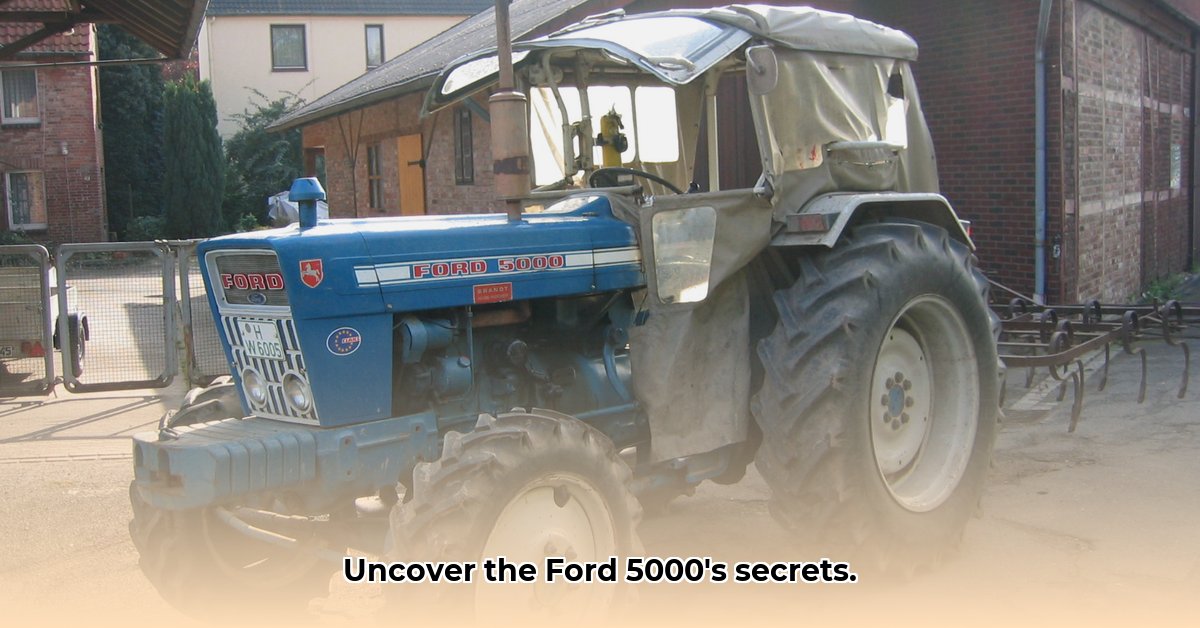
The Ford 5000 tractor: a robust workhorse of the agricultural revolution, this machine holds a significant place in farming history. This comprehensive guide delves into its technical specifications, historical context, restoration, and collector's value, providing a complete picture for enthusiasts, historians, and potential owners. We'll explore its powerful engine, versatile transmission, and enduring legacy, comparing it to its competitors and revealing both its strengths and weaknesses. For more on Ford tractors, see this useful resource.
Engine: The Powerhouse Behind the Ford 5000
The Ford 5000’s engine is the heart of its operation, offering two primary options: gasoline and diesel. Both boasted a displacement of approximately 4.2 liters (240 cubic inches for the diesel and 172 cubic inches for the gasoline), and delivered a respectable power output for their time. However, it's crucial to distinguish between drawbar horsepower (for pulling implements) and PTO (power take-off) horsepower (for powering attachments). While both engines nominally produced around 67-69 PTO horsepower, drawbar horsepower was realistically lower, likely in the 50-60 hp range, depending on the specific model and configuration. This distinction is vital when comparing its capabilities to contemporaries. Did the fuel choice, gasoline versus diesel, significantly impact the tractor's overall performance in various field conditions? Further research into operational data from the era would clarify this.
Transmission: Adaptability and Versatility
One of the key features of the Ford 5000 was its transmission options, offering farmers choices to best match their needs. Configurations included 8-speed, 10-speed full power shift, and even a sophisticated 16-speed partial power shift. This range of choices provided exceptional versatility, allowing for efficient operation across a wide spectrum of agricultural tasks. The availability of different transmission types likely reflected differing price points and the diverse needs of the farming community at the time. How did these choices impact fuel efficiency, and were there any discernible differences in reliability across the various transmission options?
Historical Context: The Ford 5000 in its Era
The Ford 5000 debuted in the mid-1960s, a period of significant advancements in agricultural machinery. This era witnessed a marked shift towards more powerful and efficient tractors. Yet, precisely determining the Ford 5000’s market position requires additional research. How did it fare against formidable competitors like John Deere, Massey Ferguson, and International Harvester? Analyzing sales figures and contemporary reviews would illuminate its standing within the larger agricultural landscape of that period. What innovative technologies did the Ford 5000 incorporate, and how did it impact farming practices?
Strengths and Weaknesses: An Objective Assessment
While highly popular and effective for its time, the Ford 5000 wasn’t without limitations. Its rugged mechanical design generally ensured outstanding reliability, minimizing downtime. However, maintaining this machine may have required more frequent servicing compared to modern tractors. The lack of a protective cab in many models exposed operators to the elements, potentially impacting both comfort and safety. Additionally, the absence of four-wheel drive likely hindered performance in challenging conditions such as muddy or hilly terrain. Therefore, while it was a durable and dependable machine, it possessed limitations compared to both its contemporaries and modern agricultural technology. What specific mechanical components were most prone to failure? This question warrants further investigation into service records and user testimonials.
Restoration and Collectors' Information: Preserving a Legacy
The Ford 5000 has cultivated a loyal following amongst collectors and restoration enthusiasts. Restoring one presents unique challenges, especially concerning parts acquisition. While some components are readily available, others necessitate extensive searching, potentially utilizing online forums, specialist suppliers, or even sourcing parts from other tractors. Common restoration challenges often involve worn mechanical components, emphasizing the importance of thorough inspection and meticulous maintenance. This labor of love requires dedication and resourcefulness, but the reward of owning and operating a restored Ford 5000 is significant for many enthusiasts. Where can restoration enthusiasts find reliable resources and expert advice? This is a key area worthy of further exploration.
Key Ford 5000 Specifications: A Quick Reference
The following table provides a summarized overview of the Ford 5000's main specifications. Note that these are approximate values; exact specifications can vary depending on the model year and configuration. Always refer to the appropriate owner's manual for precise details.
| Specification | Value | Notes |
|---|---|---|
| Engine | 4.2L Gasoline or Diesel | Approximately 67-69 PTO hp (Drawbar hp varies) |
| Transmission | 8-speed, 10-speed, 16-speed (various options) | Power shift options available |
| Drawbar Horsepower | ~50 hp (approx.) | Varies depending on engine and transmission |
| PTO Horsepower | ~60 hp (approx.) | Varies depending on engine and transmission |
| Weight | Varies based on configuration | Consult specific model documentation |
Conclusion: An Enduring Legacy
The Ford 5000 tractor stands as a testament to robust engineering and enduring design, leaving a lasting mark on agricultural history. While its technological advancements may be surpassed by modern machinery, its impact on farming practices of the era and its enduring appeal among collectors solidify its place in the annals of agricultural innovation. Its story is a compelling narrative of mechanical ingenuity and its contribution to the industry's evolution. Further research into its economic impact and its influence on subsequent tractor designs would enrich our understanding of this tractor's significance.